University of Richmond Athletics
Blog: Spider Student-Athletes Take on Civil Rights Trail Tour
10/10/2022 | General, Women's Lacrosse, Spider Leadership
Five spider student-athletes have embarked upon a fall break tour of key civil rights sites throughout Georgia and Alabama as a part of the department of athletics Civic Engagement and Co-Curricular Programming. Beginning in Atlanta, Ga., and traveling to Tuskegee, Montgomery, Selma, and Birmingham, Ala., student-athletes will engage through educational tours and speakers from Oct. 7-11.
Day 2 of the Civil Rights Trail Tour
By Logan Anderson and Kamryn Ross
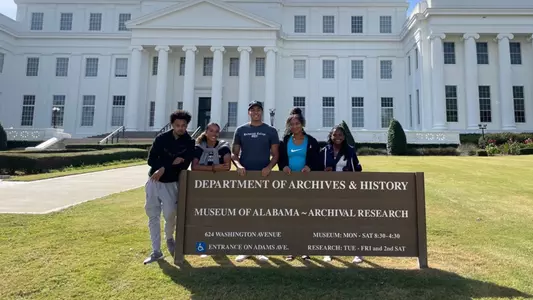
The second day of our Civil Rights Tour began in Montgomery, Ala. with a behind-the-scenes look within the Alabama Department of Archives and History. We received a personal tour with curator, Ryan Blocker. The goal of this museum is to preserve the complete history of Alabama. This department fills the gaps of American history with the stories of the disenfranchised and oppressed. Blocker noted that while many archives were found and protected, a fairly large amount have been either destroyed or lost, pushing historians like herself to continue to bring a voice to those stories unheard. Alabama has a rich history that often gets embedded with bias, as these stories find themselves told from the perspective of those in power, as those were the stories that were saved. As Richmonders traveling to Montgomery, we have a unique lens of our own, as we leave the second Capital of the Confederacy to travel to the first. This makes us think that only fifteen minutes from our campus, confederate statues once stood on Monument Avenue, and just recently were removed, yet such 'erasure' of American history remains illegal in Montgomery, much less the entire state of Alabama.
Following our time at the Alabama Department of Archives and History, we made our way down Washington Avenue to the Civil Rights Memorial Center. Here, the museum provided a timeline on the fight for civil rights that began in the 1800s and remains in 2022, encompassing the lives of all races, genders, sexes, sexual-orientations, and religions. From here we walked past the exact spot on the state capital where George Wallace proudly announced: "segregation now, segregation tomorrow, segregation forever." Standing in front of the capital was chilling. Almost sixty years later, standing on the same front lawn as individuals in support of this speech, it was personally a lot to take in, absorb, and process.
After leaving this infamous location in the heart of Montgomery, we passed the Dexter Avenue King Memorial Baptist Church in route to the Rosa Parks Museum. This museum outlines the initiation of the Montgomery Bus Boycott and sits on the exact corner where Rosa Parks was arrested on December 1, 1955. Through a holographic presentation, the museum re-enacted the night of the arrest, down to the exact conversation between her and the bus driver. While debriefing our visit on the way to the next stop, our group had an interesting discussion on why Rosa Parks was the "chosen one" to fight the system, after learning that she was not the first in this position. At the time, it was quite easy to utilize the individual's circumstances to discredit their voice. Nonetheless, the progression of this movement led to the longest protest in American history - 386 days. We can only imagine the mental strength and resilience that was required.
After a visit to the Freedom Rides Museum, our group traveled to our final destination of the day - and in our opinion, the most impactful: The Legacy Museum: From Enslavement to Mass Incarceration, which was incredibly powerful to say the least. This museum was absolutely the most visually and emotionally gripping site, as each experience within the museum was interactive and immersive. Even the building, where the museum sits, was a former warehouse where enslaved Black people were forced into bondage. As we exited, letters from juvenile and adult inmates brought a few of us to tears. The Legacy Museum brought many issues throughout history to life and does not shy away from tackling the difficult conversations, and for that, we are extremely grateful. Lastly, we visited the Peace and Justice Memorial Center, which memorialized victims of lynching's that took place for about a century in the southern states. This outdoor exhibit identified the men, women, and children killed, along with the location and the reasoning for each one – whether it be just for, "walking on the wrong side of the street." As arbitrary as it sounds, this was a legitimate circumstances that subjected one to be publicly killed, with celebration, under the pretext of justice.
We have learned so much along this journey already, and it is only the end of day two. We are thankful to have the opportunity to learn about the Civil Rights Movement in a way that is unable to be replicated by just sitting in a classroom. Walking along the Civil Rights Trail, allows us to step into the shoes of the leaders of that era and we are so appreciative for this opportunity to learn, reflect, and process during our Fall Break.