


.png&width=16&height=16&type=webp)


University of Richmond Athletics
Julie Beckwith Discusses Greg Beckwith's Legacy, Foundation Ahead of Alumni Weekend
01/29/2026 | Men's Basketball
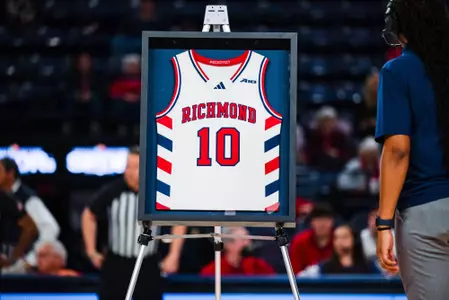
The Spiders are debuting new red throwback jerseys vs Davidson on Jan. 31. The jerseys, produced in collaboration with adidas, are inspired by those worn by the Spiders in 1985-86, Greg's senior season. The game-worn jerseys will be auctioned off through February 16, with proceeds benefitting the Greg Beckwith Foundation. Bids can be placed at https:richmondspiders.com/auctions.
Can you describe the Greg Beckwith Foundation and its mission and maybe how that mission has evolved since his passing?
The goal of the foundation is to perpetuate Greg's legacy and the Beck Effect. Greg, as most people know, was such a force of kindness, and he just touched people in a way that most people don't. He was compassionate, he was concerned. He was a great guy. He was the type of person who was interested in what other people do, and how he can help, and how he can influence or have an impact on what they were doing.
He was interested. He was sincerely interested in people, and the goal of the Beck Effect and the foundation is really just to perpetuate that legacy and find ways that we can make a difference in the lives of people that Greg would have otherwise touched were he still here.
I think JD [John Davis}, in the eulogy at the funeral, said it best. He was just a presence, and he just brought this positive energy to everything he did and everyone he knew. And, as I said at the funeral, if we don't find a way to make a difference in the world the way he did, then none of what happened to him makes any sense. If you can't perpetuate the goodness that he gave, it just doesn't make sense. The loss of Greg would just be a tragedy and not an inspiration.
How is the foundation working to continue Greg's legacy?
The first thing is working through the University of Richmond program to make sure his memory and his presence remain in the program. One of the things that was so important to him was connecting the past with the future of the program. He'd been around University of Richmond basketball for 45 years, either as a recruit, a player, a coach, a fan, a broadcaster. And that entire time, it was so important for him that the history of the program meet the future of the program and continue grow that legacy.
It was important to him that future Spiders know what it means to wear that uniform. Know what it means to be a 'Giant Killer,' what it means to be a Cinderella, and how that now makes this program not a surprise. This program went from being a Giant Killer and a Cinderella team to being a contender. It shouldn't be unexpected that Richmond is in the mix when Richmond is in the mix, because it's a legitimate program. It went from being a small sort of second-tier program to being one that teams don't want to play because they don't want to run the risk of losing to them.
So knowing that history and that legacy and moving that forward in the program was very important to him. The players of the past contributed so much to the program that the players of the future need to know that and recognize it. But then the players of the past also need the support of the players of the future. Playing college basketball is not easy. It's not an easy lifestyle. There are players who went through it before and got to the other side and got to a different type of life — being grown up and doing adult things. It's important for people to see that, and to see that you can go through this program successfully, you can transition, because most of them aren't going to continue to play basketball [beyond college].They need to know that there's something there for them on the other side, and they can transition to that. And Greg stayed involved in sports. He stayed involved with the Spiders. So this weekend is important to make sure that the former players come and interact and engage with the program and the new players. That's important.
As I look down the road, I would like to see us maybe do something with the school, through the foundation, to help current players transition into the workforce and transition into something else. This is more of a year-round sport now than it was. Greg would at least have a couple of months off in the summer. They don't even have that now. So it's very hard when you think about, 'how am I going to go get a job when I don't have time to do anything but basketball?' So, as we think about it, we might want to do something with the former players and the school to work with the current players, because we have [former] players who are doing all sorts of things.
What is the foundation focused on outside the UR community?
Continuing his relationship with Adidas. Adidas has been wonderful. Wonderful. Immediately after we lost Greg, they named their top-tier basketball tournament game after him for the girls and the boys. It's the three stripe tournament that they do down in South Carolina. And the U-18 top tier boys and girls championship is the Greg Beckwith Championship, and [daughter] Brittany designed the trophy for them. And it's a wonderful experience.
The big thing we're doing this year is we're now taking applications for our inaugural Greg Beckwith fellows class. We're hoping to identify in the first year maybe five to 10 college student athletes who will join us at the National Sporting Goods Association's annual leadership meeting in May in Nashville. They will have sort of a Sporting Goods 101 class on Sunday with members of the association, and then they'll be able to attend all the sessions, all the meetings, and all the social activities at that meeting. We hope to connect them with a mentor at that meeting. Over the course of the year the mentor will provide an internship program for them, adjusting for the athlete and the time that the athlete has available.
It's an opportunity to interact and network with all of the leaders of the sporting goods industry. The NSGA has just been amazing in their support. You know, Greg meant the world to so many of them, and he just touched so many of them. It's kind of funny. You live with someone every day. And you know who they are, and you know what they are, but sometimes you just don't realize the impact they have on so many other people.
Greg was fortunate that he was able to make his avocation his vocation. He enjoyed sports. He was able to stay around it for his entire career. And he was fortunate that it was a career that allowed him to stay connected to the [Richmond] program through his broadcasting. And athletes who aren't football or basketball players aren't always going to continue to play their sport beyond college, but they do have an interest in continuing in sports. And that's their passion. And if you can connect your passion with your job, that's a perfect world.
As in most things, it's not what you know, it's who you know. And Greg was a mentor. That's what he was. He was someone who found people by accident and expressed an interest in them and would reach out to them and check in on them or see how they were doing, or provide them advice. That's who he was.
Right after he died, the first work day back, his phone rang, at like 9:30 in the morning. I answered it, and it was a young man asking to speak to him, and I told him what happened. And there was just like this long, long pause. And I said "if you don't mind me asking what's your connection to Greg? And again, this long pause. This guy's obviously trying to process what I just said to him. And after a minute or so, he says, "he was my mentor." And I said, "Well, tell me more." And he said, "I met him last summer at a trade show, and I'm new. I was new to the industry. And he saw I had my first-time attendee badge on. We passed each other, and he stopped and introduced himself, and started talking to me. We sat down at one of the tables. I told him about myself. He told me about himself. And over the course of the year, I would reach out to him if I had a question. He would reach out to me to check in on me. And he was my mentor. And he said I was calling him for some advice. I have a job offer, and I'm calling him for his advice. And I said, "let me get this straight. You're calling a man who was a complete stranger to you six months ago to ask him for major life advice about your career?" And he said, "Yeah." And that was Greg. That's who he was.
He knew the importance of sharing his experience and being encouraging and being supportive and just being a leader. And that's what he was. He was the floor general throughout his entire life. He just gave assists throughout his entire life. He was a point guard for life. He connected people to opportunities, to each other, to experiences. So the goal of the foundation really is to help perpetuate that legacy, that role of being a point guard for other people.
Can you describe the Greg Beckwith Foundation and its mission and maybe how that mission has evolved since his passing?
The goal of the foundation is to perpetuate Greg's legacy and the Beck Effect. Greg, as most people know, was such a force of kindness, and he just touched people in a way that most people don't. He was compassionate, he was concerned. He was a great guy. He was the type of person who was interested in what other people do, and how he can help, and how he can influence or have an impact on what they were doing.
He was interested. He was sincerely interested in people, and the goal of the Beck Effect and the foundation is really just to perpetuate that legacy and find ways that we can make a difference in the lives of people that Greg would have otherwise touched were he still here.
I think JD [John Davis}, in the eulogy at the funeral, said it best. He was just a presence, and he just brought this positive energy to everything he did and everyone he knew. And, as I said at the funeral, if we don't find a way to make a difference in the world the way he did, then none of what happened to him makes any sense. If you can't perpetuate the goodness that he gave, it just doesn't make sense. The loss of Greg would just be a tragedy and not an inspiration.
How is the foundation working to continue Greg's legacy?
The first thing is working through the University of Richmond program to make sure his memory and his presence remain in the program. One of the things that was so important to him was connecting the past with the future of the program. He'd been around University of Richmond basketball for 45 years, either as a recruit, a player, a coach, a fan, a broadcaster. And that entire time, it was so important for him that the history of the program meet the future of the program and continue grow that legacy.
It was important to him that future Spiders know what it means to wear that uniform. Know what it means to be a 'Giant Killer,' what it means to be a Cinderella, and how that now makes this program not a surprise. This program went from being a Giant Killer and a Cinderella team to being a contender. It shouldn't be unexpected that Richmond is in the mix when Richmond is in the mix, because it's a legitimate program. It went from being a small sort of second-tier program to being one that teams don't want to play because they don't want to run the risk of losing to them.
So knowing that history and that legacy and moving that forward in the program was very important to him. The players of the past contributed so much to the program that the players of the future need to know that and recognize it. But then the players of the past also need the support of the players of the future. Playing college basketball is not easy. It's not an easy lifestyle. There are players who went through it before and got to the other side and got to a different type of life — being grown up and doing adult things. It's important for people to see that, and to see that you can go through this program successfully, you can transition, because most of them aren't going to continue to play basketball [beyond college].They need to know that there's something there for them on the other side, and they can transition to that. And Greg stayed involved in sports. He stayed involved with the Spiders. So this weekend is important to make sure that the former players come and interact and engage with the program and the new players. That's important.
As I look down the road, I would like to see us maybe do something with the school, through the foundation, to help current players transition into the workforce and transition into something else. This is more of a year-round sport now than it was. Greg would at least have a couple of months off in the summer. They don't even have that now. So it's very hard when you think about, 'how am I going to go get a job when I don't have time to do anything but basketball?' So, as we think about it, we might want to do something with the former players and the school to work with the current players, because we have [former] players who are doing all sorts of things.
What is the foundation focused on outside the UR community?
Continuing his relationship with Adidas. Adidas has been wonderful. Wonderful. Immediately after we lost Greg, they named their top-tier basketball tournament game after him for the girls and the boys. It's the three stripe tournament that they do down in South Carolina. And the U-18 top tier boys and girls championship is the Greg Beckwith Championship, and [daughter] Brittany designed the trophy for them. And it's a wonderful experience.
The big thing we're doing this year is we're now taking applications for our inaugural Greg Beckwith fellows class. We're hoping to identify in the first year maybe five to 10 college student athletes who will join us at the National Sporting Goods Association's annual leadership meeting in May in Nashville. They will have sort of a Sporting Goods 101 class on Sunday with members of the association, and then they'll be able to attend all the sessions, all the meetings, and all the social activities at that meeting. We hope to connect them with a mentor at that meeting. Over the course of the year the mentor will provide an internship program for them, adjusting for the athlete and the time that the athlete has available.
It's an opportunity to interact and network with all of the leaders of the sporting goods industry. The NSGA has just been amazing in their support. You know, Greg meant the world to so many of them, and he just touched so many of them. It's kind of funny. You live with someone every day. And you know who they are, and you know what they are, but sometimes you just don't realize the impact they have on so many other people.
Greg was fortunate that he was able to make his avocation his vocation. He enjoyed sports. He was able to stay around it for his entire career. And he was fortunate that it was a career that allowed him to stay connected to the [Richmond] program through his broadcasting. And athletes who aren't football or basketball players aren't always going to continue to play their sport beyond college, but they do have an interest in continuing in sports. And that's their passion. And if you can connect your passion with your job, that's a perfect world.
As in most things, it's not what you know, it's who you know. And Greg was a mentor. That's what he was. He was someone who found people by accident and expressed an interest in them and would reach out to them and check in on them or see how they were doing, or provide them advice. That's who he was.
Right after he died, the first work day back, his phone rang, at like 9:30 in the morning. I answered it, and it was a young man asking to speak to him, and I told him what happened. And there was just like this long, long pause. And I said "if you don't mind me asking what's your connection to Greg? And again, this long pause. This guy's obviously trying to process what I just said to him. And after a minute or so, he says, "he was my mentor." And I said, "Well, tell me more." And he said, "I met him last summer at a trade show, and I'm new. I was new to the industry. And he saw I had my first-time attendee badge on. We passed each other, and he stopped and introduced himself, and started talking to me. We sat down at one of the tables. I told him about myself. He told me about himself. And over the course of the year, I would reach out to him if I had a question. He would reach out to me to check in on me. And he was my mentor. And he said I was calling him for some advice. I have a job offer, and I'm calling him for his advice. And I said, "let me get this straight. You're calling a man who was a complete stranger to you six months ago to ask him for major life advice about your career?" And he said, "Yeah." And that was Greg. That's who he was.
He knew the importance of sharing his experience and being encouraging and being supportive and just being a leader. And that's what he was. He was the floor general throughout his entire life. He just gave assists throughout his entire life. He was a point guard for life. He connected people to opportunities, to each other, to experiences. So the goal of the foundation really is to help perpetuate that legacy, that role of being a point guard for other people.

Monday, September 21
Wednesday, August 05
Monday, July 27
Friday, July 17