University of Richmond Athletics
One Day At A Time
01/06/2003 | Women's Basketball
Jan. 6, 2003
By Andrew Blair
It's practice time for the University of Richmond women's basketball team today and five guys mosey onto the hardwood as the women's team prepares to scrimmage in preparation for an upcoming game.
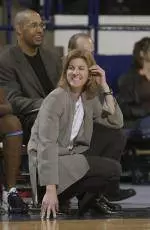
For the women's squad, sweat plasters their blue and white Richmond jerseys as they march onto the floor with their orders. Cut. Move. Attack pressure. Value the ball. The usual coach-speak. But there's hardly anything ordinary about Richmond's brilliant first-year women's basketball coach Joanne Boyle, who has brought this collection of players together as a team, both literally and figuratively.
She's not trying to make news by attempting to overpower an opponent, who is bigger at least physically. In part, this practice habit, while not unique in and of itself, lies at the essence of Coach Boyle's ambitious course for the program - one she now calls her own, following nine years as an assistant women's coach at national power Duke, which amassed a 265-67 record during her tenure.
At Richmond, Boyle, 38, has afforded her squad a different outlook on basketball and another opportunity to make their own destiny following the program's two sub-.500 seasons in the past three years. You see, Joanne Boyle appreciates the importance of having a second chance in life.
In late November 2001, she was at an entirely different point in her life, an assistant coach for the Gail Goestenkors-coached Duke squad, a team front and center on the national stage ultimately headed to their second Final Four in the past four years. She had considered other coaching positions a year earlier. "Why rush it?" she thought. Duke is home, at least for now, she knew. After all, in addition to coaching at Duke, she was comfortable in its environment and the security the school provided. In addition, Boyle enjoyed a distinguished academic and playing career at the institution as a four-year starter (1981-85), helping the program set records for most wins and most Atlantic Coast Conference victories in a season, before graduating with a degree in economics.
On Nov. 28, 2001, it was a clear, sunny Durham, N.C., day, with temperatures peaking in the mid-70s. A voracious runner, Boyle was preparing for an upcoming national marathon and decided to get in a morning jog prior to the team's afternoon practice. Friends and colleagues who know Boyle well say that she is one the most efficient people they have ever encountered. Rarely is a moment wasted in her day. Oftentimes at Richmond, her office door at the Robins Center doesn't close until well into the evening after the last immediate issue involving the team or a final call to a recruit for the day has been completed.
 "She's always doing something," says Richmond women's assistant coach Ginny Doyle, who has been on the Spiders' staff since 1999 and was a three-year starter for the program from 1990-92. "Her work ethic is unbelievable. She uses every second of every minute of the day."
What a beautiful day, thought Boyle, smiling that day at Duke. What a great time to be alive. The next hour was as normal as her life was going to be for a while.
Following her usual run around the Duke trails, which wind through its campus, Boyle returned for a short meeting, then showered and was drying her hair in the locker room at the Schwartz-Butters Athletic Center adjacent to Cameron Indoor Stadium. Then, suddenly she felt a sharp pain, like something she had never experienced before. Initially, Boyle thought she had been electrocuted. Always committed to staying and maintaining great physical conditioning, she had never encountered any serious health problems. Heck, she's a marathoner. This was different though. This wasn't fatigue - it was more than exhaustion from another hour-long run.
"I had this feeling of a knife going through my head," Boyle recalls.
It's probably nothing, she tried to convince herself. But the constant throbbing would not cease. Things were getting worse, not better. Remembering the time, today she says, "I thought my nerves were on fire, like something had exploded in my body."
What is going on?, she wondered.
Boyle walked down a long, narrow hallway, past a weight room and managed to somehow make it to the elevator to get to the team's women's basketball office on the fourth floor at Cameron. Please let the elevator be here, her conscience begged the rest of her body. Seemingly ready to collapse, Boyle's body managed to find the fourth floor, where Duke women's assistant coach Gale Valley found Boyle. Using a nearby wall for support, Boyle was pale and barely able to stand.
"What is wrong with you?" asked a worried Valley, when she saw her fellow coach slumped over just outside the elevator.
"I don't know," managed a more worried Boyle.
Initially, coaches and players thought it might be dehydration. Boyle found a seat but it didn't provide any comfort. Her arms flailing and head sinking, Boyle's speech became slurred and, normally known for her gregarious personality and out-going, conversational nature, found herself barely able to talk. A member of the staff immediately called an ambulance to take her to Duke University Medical Center.
At about the same time, Loren Rice, who played at Duke a year earlier, was in Atlanta, happened to call that day and was talking with one of the team's assistant coaches in Duke's women's basketball offices and heard about the incident.
Rice e-mailed Georgia Schweitzer, Duke's All-America forward who graduated a year earlier and whose career Boyle played a major role in developing, both on and off the court. Schweitzer had planned on attending medical school and, with a major early assist from Boyle, shadowed neurologist Dr. Henry Friedman during her last two years of college to gain a better understanding of the demands of the profession. At the time, Schweitzer was substitute teaching while at her home near Columbus, Ohio following her first season playing for the WNBA's Minnesota Lynx. Rice described the symptoms and indicated that they thought it might be dehydration. Schweitzer knew better.
"What she was describing to me wasn't dehydration," recalls Schweitzer.
Moments later, Schweitzer hung up, picked up the phone and called Dr. Friedman, co-director of The Clinical Neuro-Oncology Center of The Brain Tumor Center at Duke University, and a mutual friend of both she and Boyle's. In addition to mentoring Schweitzer, Dr. Friedman was passionate about Blue Devil women's basketball and a regular at the team's home games. Schweitzer told Dr. Friedman what she thought she knew from Rice's communication. Shortly thereafter, Dr. Friedman went to the emergency room and contacted his partner, Dr. Allan Friedman ("I'm better looking and a better athlete and we are no kin," Dr. Henry Friedman once laughed, before praising his colleague for his expertise in the next instant), considered one of the top five neurosurgeons in the country, to help diagnose and take care of Boyle. Planning to attend a medical conference at the time, Dr. Allan Friedman canceled the trip and returned immediately once he learned of Boyle's ordeal.
Upon arriving at Duke University Medical Center, the doctors ran a magnetic resonance imaging (MRI) test and angiogram on Boyle. They thought it might be an ateriouvenous malformation (AVM), a capillary deficiency in which the flow of blood from the arteries to the veins causes a bursting of the blood vessels in the area. As they suspected, preliminary tests weren't overly revealing, but doctors knew she had bleeding in the base of her skull and the blood was pushing on her nerve endings, preventing her from moving.
"It was like being paralyzed," Boyle remembers.
For all the successes she had helped to build at a fledging Duke program, the days following her hospitalization were the most challenging in Boyle's life. For the first time ever, she knew what it was like not to be self sufficient, unable to come and go as she pleased nor communicate verbally, much less coach. So this is it, she thought. This is my life.
On the 13th day of her hospitalization, Dec. 7, 2001, Dr. Allan Friedman walked into Boyle's hospital room with some news. In essence, the doctors determined that she had a massive brain bleed and indicated that she needed to undertake an extended rehabilitation program. Before committing her to rehab though, Dr. Allan Friedman ordered one more angiogram. Following the test, he diagnosed the AVM on the left portion of her cerebellum, a less tenuous part of the brain, according to doctors. So much for rehab, at least for now. Surgery was imminent.
"When they found something, I was happy because I knew they could fix it and make things better, instead of them not finding something and wondering how the heck I was going to live the rest of my life," Boyle says.
On Dec. 8, Boyle underwent the first major surgery of her life and one that would ultimately save her life. Doctors cut three inches into Boyle's skull, inserting a plate in her brain and ridding Boyle of the pressure of blood on her brain. They immediately saw results and Boyle was talking again, though no one could understand her because her words were still so slurred. Boyle remembers the feeling.
"I knew what I wanted to say, but my mouth wouldn't let me say what I wanted to," recalls Boyle, who later underwent a brief rehab at Durham Regional Hospital. "I had to re-learn everything. People were laughing at me because they couldn't understand what I was saying, but at least they knew I was talking. I was like 'Chatty Cathy.' I couldn't hold anything but I could at least move my hands."
 As committed to rehab as she is to all other aspects of her life, Boyle's road back included both physical and speech therapy and she rejoined the Duke program on a part-time basis on Jan. 1, 2002 before resuming full-time duties, including recruiting, shortly thereafter. She regained 10 of the 20 pounds she shed and ran as many as 40 minutes a day on a treadmill as if to say to her illness: Take that.
Still, some scars remained, even beyond the line tracing the back of her head from surgery. Though doctors indicated that AVM is a one-time condition - once you remove the AVM it's gone - they were speaking only in medical terms. Emotionally, reality jolted Boyle again later that year at the ACC tournament in Greensboro.
On March 3, an article profiling Boyle's remarkable comeback appeared in the Greensboro News-Record, written by reporter Jim Schlosser called "Sports Grapevine Helped Save Life." A spectator at the tournament spotted Boyle and mentioned he saw the article and had a similar condition as Boyle, with one exception. They talked and Boyle learned his AVM was the size of a grapefruit and inoperable. Translation: He was going to be here one day and gone the next instant because of his AVM condition, akin to someone flipping a light switch on then off. He was 22 years old.
Though she admits to a slight break in her speech and some weakness on her left side, Boyle admittedly feels fortunate these days. Today, her spirit is as strong as it has ever been. To this day, she believes there is a bigger reason she underwent brain surgery successfully and admittedly has a greater appreciation for the precariousness of one's position in life.
"People say, 'I can't believe you went through that,'" says Boyle, who received between 300-400 e-mails of prayers during her hospitalization and received constant support via visits from family and friends. "Honestly, I think: 'Thank God I went through that.' It changed everything about my life. It changed what's important to me. It really helped me be a better coach in terms of patience, listening and understanding.
"You know what? This job is not about wins and losses. If that is all it's about then you are in the wrong business. It's about developing relationships, about understanding where everybody else is coming from. It's about giving back, about having a second chance."
Energized by that same feeling of having another shot at life, that spring Boyle began considering the idea of pursuing a head coaching position. A year earlier, she had pursued the head coaching job at Saint Joseph's, a small, private A-10 school located just outside of Philadelphia, before ultimately withdrawing her name from consideration. Had it been the right move?, she wondered for a short time following the decision.
In the spring of 2002, Debbie Antonelli, an ACC television analyst whom Boyle knew and respected, was in Durham to broadcast one of the Blue Devils games. Antonelli knew that there was a vacancy at Richmond and though initially a bit tentative because of Boyle's recent health problems, mentioned the opening and believed Boyle would be the ideal candidate.
Boyle indicated an interest and the next day, Richmond's director of athletics Jim Miller contacted her for an interview. Following Duke's 77-68 victory over South Carolina in the East Regional finals on March 25 in Raleigh, Miller stopped Boyle and made arguably one of the most important hires in Richmond women's basketball history. So impressed was Miller with Boyle during their visit that he did not interview anyone else for the position.
"Joanne was very much the type of person we wanted for our program," says Miller. "It was a matter of who was the best 'fit' and Joanne has not only the skills, but also the patience to build a program."
Boyle accepted the next day, told Goestenkors - and no one else inside basketball. At the time, Duke was headed to the Final Four in San Antonio and the Spiders had a new coach, its 16th in the 83-year history of the program. After Oklahoma derailed the Blue Devils pursuit of their first national championship in women's basketball at the Final Four in San Antonio on March 29, the Duke team took the long plane ride back to Durham. Once they landed and returned to campus, a tearful Boyle announced that she was headed to Richmond.
Though she knew of Boyle's decision days earlier, Goestenkors saw the move as another step in her colleague's career progression. Goestenkors had known her from the days of hiring Boyle as Duke's restricted earnings head coach in 1992. Boyle had just returned from playing, coaching and working overseas in both Luxemburg and Germany and visited Duke occasionally to exercise or visit friends when she returned to the U.S. Reflecting on their initial visit, Goestenkors, who had never met Boyle before, noted that she "knew within five minutes that Joanne was someone special."
Looking back, the near-death experience helped Boyle in the decision-making process when deciding to become the coach at Richmond.
"I think it gave me the courage to take the job," says Boyle, whose health has since flourished. She has resumed competitive running, completing the SunTrust Richmond Marathon last summer in 4 hours, 8 minutes. "I don't know if I would have taken the job if that would not have happened. I said, 'If I can live through brain surgery, what could be so hard about being a head coach?' It gave me strength."
For Boyle, Richmond's program possessed many of the same qualities as Duke, namely an academically rigorous private institution that demands its student-athletes achieve on the court and in the classroom. At Richmond, she faces similar challenges that Duke encountered during the early-'90s. A season prior to her arrival, Duke registered a 12-15 record. They haven't posted a losing season since, advancing to the NCAA Tournament in each of the past eight seasons. Boyle, and those who know her, think that the Spiders can ultimately achieve similar successes. Goestenkors is one of her many believers.
"Anyone who meets Joanne knows that she is very genuine," says Goestenkors, whose Blue Devils have been ranked No. 1 in every women's basketball poll imaginable throughout the 2002-03 season. "If you talk to her for five minutes, you know that this is someone I can trust and a parent knows that this is someone I know I can trust with my daughter over the next four years. She has a tremendous work ethic, passion and love for the game and goes out of her way to help others. She's got the total package. "
 When she took over the program reigns, Boyle saw a talented team in desperate need for a priority change from an offensive mindset to a defensive focus. The altered philosophy and Boyle's own passion for the program resulted in Richmond's 9-2 beginning to the 2002-03 campaign. In addition, early in the season Richmond was garnering votes in the Associated Press top 25 poll. Through the first part of the campaign, the Spiders defense was yielding less than 62 points per game, forcing more than 20 turnovers per outing and out-rebounding their opponents by nearly five boards per contest.
"I think if you put people on the floor that will work hard, play defense and rebound, you will always have a chance to win," says Boyle. "There is an understanding among our players that they are not going to play unless they play defense. When we play great defense, our players have seen the success; they've seen us win, so they buy into it and are committed. Defense is a part of this team's identity now."
Boyle has also demanded that her team get stronger and quicker, by practicing and playing against personnel bigger and faster than her squad as the Spiders prepare to face Atlantic 10 Conference teams, a league known for its ultra-competitiveness and physical play. She has required that the Spiders play defense, clog passing lanes and force turnovers - just a luxury before her arrival - by reserving a seat next to her on the bench if they resist today. She has installed a motion offense that, while still finding its permanent place among the players, emphasizes teamwork, movement and unselfishness. The Spiders are again ranked first in the Atlantic 10 in scoring offense. Though she is quick to credit the players for the team's successes, Boyle's arrival has proven therapeutic.
"We're playing with a whole new intensity this year and more than any other year, we're taking the lead from her," says senior guard Elise Ryder. "She won't settle for us being 'average.' If we are doing a drill in practice, we do it until we do it right, because she demands it. She won't let us be content. I think things are more competitive all-around, but there is also more hunger and intensity this year."
Boyle has nurtured the careers of senior center Ebony Tanner and the team's all-everything, sophomore forward Kate Flavin, one of the most complete players in program history. The duo were also the only teammates to rank in the top five in the Atlantic 10 in both scoring and rebounding. Tanner led the league in scoring, while Flavin was among the top five in seven of the conference's 12 statistical categories. Flavin accounted for six double-doubles (double figure points and double figure rebounds) and Tanner added five through the Spiders first 11 games.
"She's given me a lot of confidence," notes Flavin.
Flavin pauses for a moment. Then: "What she says - I value it a lot."
Boyle has successfully made the transition from working with a team ingrained with All-America players at nearly every position at Duke to coaching a group that relies on the sum of its collective parts for success at Richmond. Duke is scorching its opponents, in part, because the tinder is stacked so high. The philosophy is different at Richmond. In eight of the Spiders nine victories of the season, at least four players reached double figures in points.

"Would I turn down talent? No." Boyle says. "Would I turn away these kids to have more talent? Absolutely not. I think some of [Richmond's] kids are playing above the level they did in the past. I'm getting more out of them and they are seeing more about themselves than I could have possibly imagined in my first year."
Says Goestenkors: "She's doing a great job [at Richmond]. I think her tremendous work ethic and attitude has rubbed off on her players. I see great things for [Richmond's] program."
In addition to one-on-one visits in communicating with each student-athlete individually, Boyle often uses motivational messages to inspire her team throughout the marathon season. Prior to the Spiders' 79-51 rout of cross-town rival VCU on Dec. 15 (one year and one week following her surgery), extending the team's win streak to three games, she wrote a message on the team's white board, appropriate as ever to the program and its leader.
"Your big opportunity may be right where you are now," Boyle's reminder read.
Author Andrew Blair is a former UR Assistant Sports Information Director who's primary responsibility was women's basketball. He is now Communications Manager for the Virginia State Golf Association and is a regular at Spider home games.