University of Richmond Athletics
Outside the Lanes: Stensby Style
09/28/2011 | Women's Swimming & Diving
Sept. 28, 2011 - Body-Dolphin Drill
Body Dolphin (a.k.a. Dolphin Pull)
In this
installment of Stensby Style, we're going to discuss one of the drills that the
University of Richmond women's swim team (SpiderSwim) performs on a routine
basis. The Water Spiders Masters group has also done this drill with success a
couple of times. The drill we will be
discussing today is called the Body Dolphin (or Dolphin Pull).
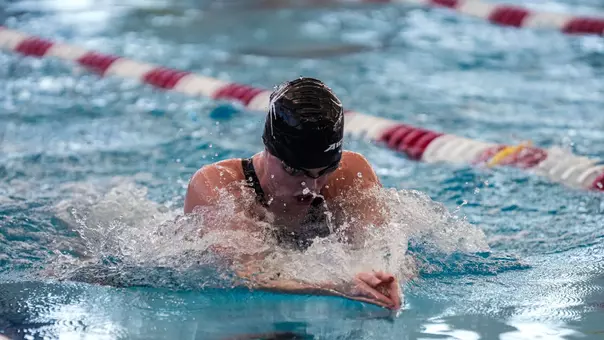
We all know how important it is to use your body when you are swimming breaststroke and butterfly. The body-dolphin drill helps reinforce using your whole body to kick while also providing an avenue for swimmers to learn a quick tempo for the short-axis strokes (butterfly and breaststroke).
First, let's take some time to discuss the background on the four strokes. While you advanced folks may feel inclined to skip ahead, a little review never hurts...
Historical Background
Historically,
or at least in my swimming circles, freestyle and backstroke are referred to as
"the long-axis" strokes. This name is derived from the natural rotation of the
stroke around the body's longest axis. Imagine a line that extends from your
head to your toes through the middle of your body.
Similarly, butterfly and breaststroke are known as "the short-axis" due to the undulating motion of the strokes. The short axis of the body can be imagined by drawing a horizontal line through the hips. In these two strokes your body makes a motion that my engineering mind wants to associate with a sine or cosine wave. (I heart math. If you're not a math person, you can see what this looks like here.)
The Drill - Body Dolphin
Now that we
have the basics down, we can discuss the drill. The body-dolphin drill is used to establish a
quick tempo in the short-axis strokes. This drill is a cross between
breaststroke and butterfly. Thus this drill can be used to help improve both
strokes, although there is NO breaststroke kick or pull. The swimmer will try
to quickly pulse their way down the pool using their entire body to initiate a
dolphin kick. Some people refer to this as an undulating motion with their body.
Here are the rest of the components of the drill and some of the keys to
properly performing this drill:
1. Hands - A swimmer's hands should be extended in front of their body. The hands and arms will be used for balance, not for propulsion. The hands will scull out and in (think old-school wiper drill) to help the swimmer use the whole body to derive the kick. This sculling motion with the arms also helps a swimmer start to time the beginning of the pull with the motion of the body.
2. Breathing - The other key to this drill is the timing of the breath. The swimmer should be taking a breath with every body-dolphin. As the swimmer up-kicks, the hips will be forward, shoulders will be back and the body will be in a great position to take a breath naturally. The swimmer should return their face to the water as they are kicking down and pushing the hips back to the surface.
3. Kicking with Rhythm - One common error in the short-axis strokes is not having a rhythm to the up-kick and the down-kick. The down-kick and the up-kick should not be separate but rather a continuous motion stemming from the entire body movement. There should be continuity between the up-kick and down-kick. The end of the up-kick should transition into the beginning of the down-kick and vice versa, both kicks being derived from the core. (Did I say core enough yet?)
4. Hips Up - Swimmers must make sure they are kicking with the entire body. A simple way to determine if a swimmer is using their whole body can be seen in the gluteus maximus or their hips (interchangeable terms in this instance). If the gluteus maximus comes out of the water, the swimmer is most likely performing the drill correctly. If a swimmer is struggling with the drill, they can focus on getting their gluteus maximus or hips out of the water.
Positive Aspects of the Drill
• Creates a positive uplifting motion for dolphin-kick.
Hips forward as the feet lift up, hamstrings engaged
• Creates quick tempo for short-axis strokes.
• Enforces the continuity of a good kick where the
up-kick continues into the down-kick and creates one motion with "flow".
• Creates timing for short-axis strokes, timing
for both the breath and the pull.
Drills to Help the Drill
As in the
case with some drills, you need drills to help reinforce the drill that you are
trying to perform. Another great drill that helps create the quickness in a
full body motion of the body dolphin is an all-out vertical kick drill.
Sample Progression
Here is a
sample progression that you can work through to help your short axis strokes:
1. Big vertical kicking (30 seconds or longer)
2. Small fast vertical kicking blasts (No more than 20 seconds, with ample rest)
3. Body-Dolphin (No more than 50 yards or meters, with ample rest)
4. Swim butterfly with quick tempo (Again short bursts, possibly even 15-meter reps)
Sample Set
• 4 x 30
seconds vertical Dolphin kick @ 15 seconds rest
• 4 x 10
seconds vertical Dolphin kick blast @ 20 seconds rest
• 8 x 25
Body-Dolphin @ 40 seconds
• 8 x 25
Sprint Fly @ 30 Seconds
If you have questions or comments about any of this drill, please feel free to email me at tstensby@richmond.edu. I always look forward to and enjoy feedback.