
University of Richmond Athletics
Spiders Arrive In Cape Town, South Africa - Blog Post #3
05/21/2018 | Football, General, Women's Basketball, Women's Track & Field, Men's Basketball
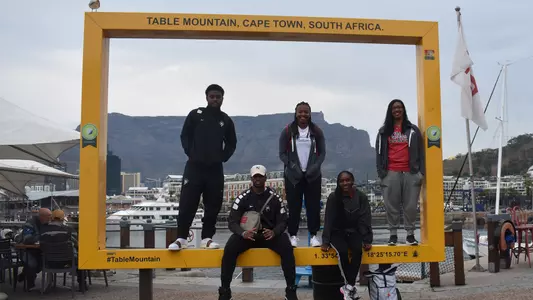
Junior football student-athlete Kevin Johnson, sophomore men's basketball student-athlete Nick Sherod, freshman women's basketball student-athlete Alex Parson and junior women's track student-athlete Marshea Robinson will spend May 16-27 exploring South Africa and the United Arab Emirates. Throughout their trip, the student-athletes will be reporting back to www.RichmondSpiders.com with blogs documenting their journey.
Blog Number Three – By Marshea and Alex
Today our day started exactly at 12 am, we packed up our bags, headed to the Dubai airport and waited for our 3am flight. We walked around and picked up some food as we prepared for the 9 hour trek to South Africa. Once we arrived in Cape Town, South Africa, we instantly noticed how different Dubai and Cape Town were. We were not sure what to expect, but we were all commenting on how Dubai was more developed and Cape Town appeared to have more poverty. Throughout our tour of the city, we saw children begging, people without shoes, and cardboard boxes used as shelter. We were informed of the unemployment rates— Cape Town around 26% and all of South Africa reaching 37%. This was surprising at first, but we later learned more about the significance of the history and its impact upon the country.
Another difference we noticed was within the diversity of people in the two locations. In Dubai, there were people of all different shapes and skin colors, but in Cape Town we noticed a different type of diversity. Cape Town, specifically as we toured Victoria and Alfred Wharf, was filled with peoples of varying ages and different sexual orientations. There were same-sex couples, various age groups gathering together at a local restaurant, and couples with different skin colors. It was exciting to see this inclusivity embraced openly in South Africa because we saw none of it in Dubai. Due to the religious nature, homosexuality is seen as a sin in Islamic culture. It is a topic kept behind closed doors, and we wonder if the UAE will ever be ready to discuss such issues of social justice.
(Marshea)
As our tours continue, we recognize how much knowledge we lack. Alex mentioned this discovery, and it was profound but sadly true. The history currently taught in our academic systems are told from the European perspective, ignoring key details. One interesting detail about Cape Town was the reclaiming of the land after colonialism. We learned about the Slave Lodge, which housed slaves during the late 17th and 18th centuries, but now serves as a museum for visitors. Although we have yet to visit the Slave Lodge, we did learn about the effects of slavery on the population. Racism, discrimination, and poverty are just a few of the effects that led to the continued underdevelopment of the country today, aside from Apartheid. Not far from the Slave Lodge is the Bo-Kaap, formerly known as the Malay Quarter. The Quarter was a collection of rental houses built and leased to slaves for living. The slaves were restricted to keeping the houses white, but as regulations were uplifted, the slaves painted these homes with bright colored paint as an expression of their freedom. The Bo-Kaap now serves as a beautiful location bringing smiles to its visitors' faces.
(Alex)
Our welcome lunch was at a restaurant called Balducci's. They offered a variety of foods, but I wanted to try something new, so I ordered the Kingklip. For those that don't know, the Kingklip is a type of fish that belongs to a species of eel. This type of fish is native to the South African coast and is very popular. I really did my research before ordering because I am not a fan of seafood at all. This was really important to me because I felt like I was stepping outside of my comfort zone. Marshea tasted some as well and enjoyed it, so we are exploring with more than just our eyes and opening ourselves up to new things.
(Both)
Our first day in Cape Town was an experience by itself and it was interesting to hear perspectives from a native South African. Anthony, our tour guide, has lived in South Africa for his entire life. He tells us stories about his childhood, the educational systems and institutions, and how South Africa has grown in front of his eyes. He has countless memories to share with us, and we love hearing new stories every time we gather. Another friend filled with knowledge is Justin Grove, a former University of Richmond soccer player who owns a soccer academy in Cape Town that we will be visiting later in the week. Be on the lookout for our blog on our visit to the Grove Soccer Academy. Before departing, Justin told our group, "to forget everything you think you know about South Africa." Honestly, we did not know what to expect before arriving, but in the back of our minds, we still had our own preconceived ideas of what Cape Town would be like and now we are so grateful to be able to experience the country for ourselves, and gather our own stories and opinions to be able to share with our community.
With much love,
Marshea Robinson and Alex Parson
Blog Number Three – By Marshea and Alex
Today our day started exactly at 12 am, we packed up our bags, headed to the Dubai airport and waited for our 3am flight. We walked around and picked up some food as we prepared for the 9 hour trek to South Africa. Once we arrived in Cape Town, South Africa, we instantly noticed how different Dubai and Cape Town were. We were not sure what to expect, but we were all commenting on how Dubai was more developed and Cape Town appeared to have more poverty. Throughout our tour of the city, we saw children begging, people without shoes, and cardboard boxes used as shelter. We were informed of the unemployment rates— Cape Town around 26% and all of South Africa reaching 37%. This was surprising at first, but we later learned more about the significance of the history and its impact upon the country.
Another difference we noticed was within the diversity of people in the two locations. In Dubai, there were people of all different shapes and skin colors, but in Cape Town we noticed a different type of diversity. Cape Town, specifically as we toured Victoria and Alfred Wharf, was filled with peoples of varying ages and different sexual orientations. There were same-sex couples, various age groups gathering together at a local restaurant, and couples with different skin colors. It was exciting to see this inclusivity embraced openly in South Africa because we saw none of it in Dubai. Due to the religious nature, homosexuality is seen as a sin in Islamic culture. It is a topic kept behind closed doors, and we wonder if the UAE will ever be ready to discuss such issues of social justice.
(Marshea)
As our tours continue, we recognize how much knowledge we lack. Alex mentioned this discovery, and it was profound but sadly true. The history currently taught in our academic systems are told from the European perspective, ignoring key details. One interesting detail about Cape Town was the reclaiming of the land after colonialism. We learned about the Slave Lodge, which housed slaves during the late 17th and 18th centuries, but now serves as a museum for visitors. Although we have yet to visit the Slave Lodge, we did learn about the effects of slavery on the population. Racism, discrimination, and poverty are just a few of the effects that led to the continued underdevelopment of the country today, aside from Apartheid. Not far from the Slave Lodge is the Bo-Kaap, formerly known as the Malay Quarter. The Quarter was a collection of rental houses built and leased to slaves for living. The slaves were restricted to keeping the houses white, but as regulations were uplifted, the slaves painted these homes with bright colored paint as an expression of their freedom. The Bo-Kaap now serves as a beautiful location bringing smiles to its visitors' faces.
(Alex)
Our welcome lunch was at a restaurant called Balducci's. They offered a variety of foods, but I wanted to try something new, so I ordered the Kingklip. For those that don't know, the Kingklip is a type of fish that belongs to a species of eel. This type of fish is native to the South African coast and is very popular. I really did my research before ordering because I am not a fan of seafood at all. This was really important to me because I felt like I was stepping outside of my comfort zone. Marshea tasted some as well and enjoyed it, so we are exploring with more than just our eyes and opening ourselves up to new things.
(Both)
Our first day in Cape Town was an experience by itself and it was interesting to hear perspectives from a native South African. Anthony, our tour guide, has lived in South Africa for his entire life. He tells us stories about his childhood, the educational systems and institutions, and how South Africa has grown in front of his eyes. He has countless memories to share with us, and we love hearing new stories every time we gather. Another friend filled with knowledge is Justin Grove, a former University of Richmond soccer player who owns a soccer academy in Cape Town that we will be visiting later in the week. Be on the lookout for our blog on our visit to the Grove Soccer Academy. Before departing, Justin told our group, "to forget everything you think you know about South Africa." Honestly, we did not know what to expect before arriving, but in the back of our minds, we still had our own preconceived ideas of what Cape Town would be like and now we are so grateful to be able to experience the country for ourselves, and gather our own stories and opinions to be able to share with our community.
With much love,
Marshea Robinson and Alex Parson


Players Mentioned

QB
/ Football
G
/ Women's Basketball
Sprints
/ Women's Track & Field
G
/ Men's Basketball2026 SPIDYS Awards
Thursday, April 09
Special Olympics Virginia - Track and Field
Thursday, April 09
Giles-Spratley Collegiate Post
Tuesday, April 07
Blake Houser Making Offseason Strides
Tuesday, April 07